How to reduce no-shows: evidence and a reminder schedule
Research on appointment reminders, the arithmetic for your own no-show rate, and a three-step reminder schedule with baseline tracking and waitlist follow-up.
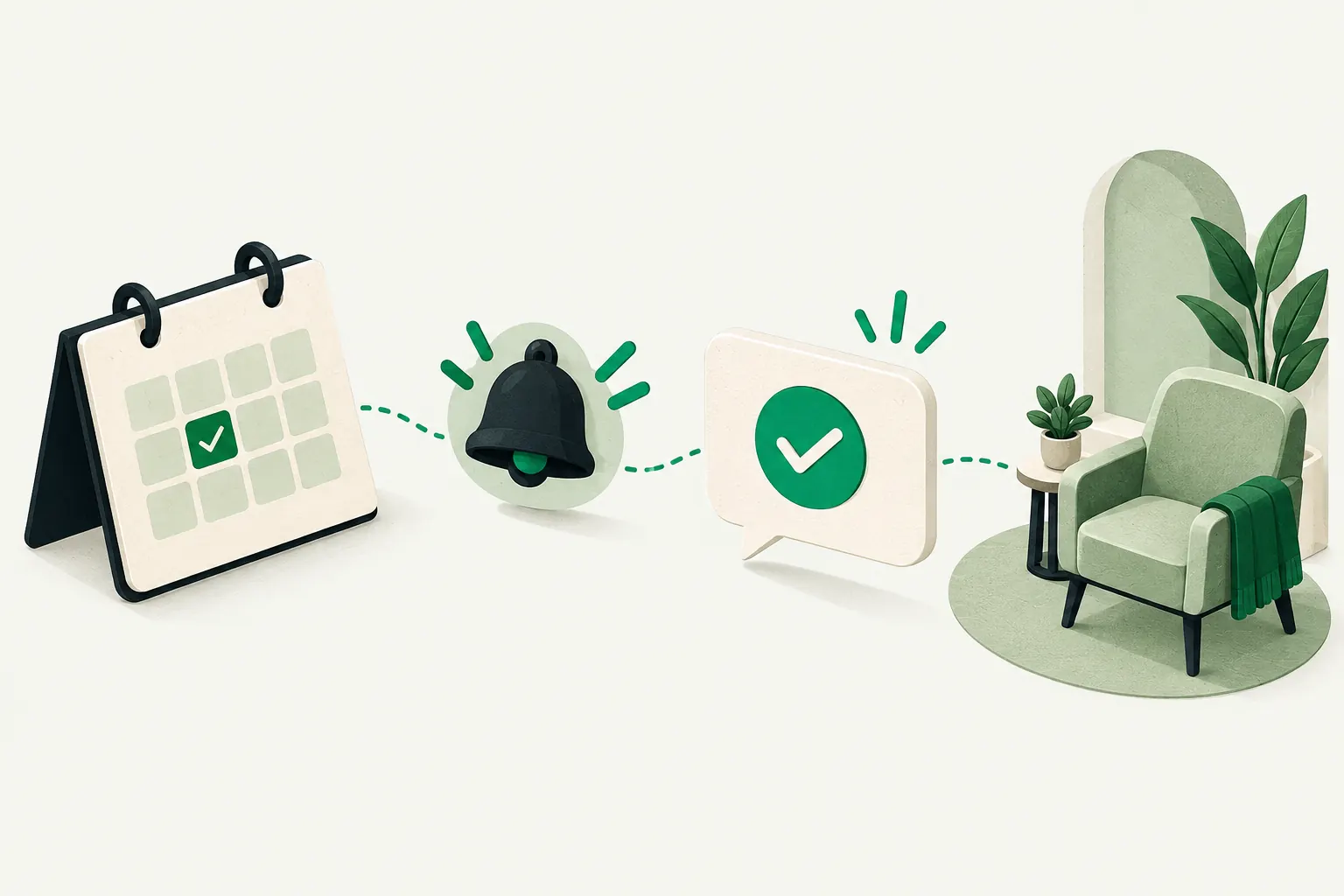
A single no-show can cost a full day's rate. Over a month, empty chairs add up. A consistent reminder system can help reduce them.
We used to claim that automated reminders cut no-shows by half, and we could not point to evidence behind that sentence. The research supports reminders, but the size of the reduction depends on your starting no-show rate.
What the trials found
A Cochrane systematic review of mobile phone messaging reminders for appointment attendance (Gurol-Urganci and colleagues, 2013, review CD007458) included eight randomised controlled trials and 6,615 participants.
Against no reminder, seven studies with 5,841 participants found improved attendance with text reminders: risk ratio 1.14, 95% confidence interval 1.03 to 1.26, on moderate-quality evidence. Against phone-call reminders, three studies with 2,509 participants found similar attendance: risk ratio 0.99, 95% confidence interval 0.95 to 1.02. Text reminders cost less per attendance.
These are healthcare appointments. The results do not establish the same effect for haircuts, tattoo sittings or other studio services.
An example with a hypothetical 10% lift
An improvement in attendance and a reduction in no-shows use different denominators. The 10% relative lift used below is a hypothetical input, not the review's estimate or a prediction for your studio.
Suppose 20 out of every 100 booked clients currently do not turn up, so your attendance rate is 80%. Apply that hypothetical 10% relative improvement and attendance goes to about 88%. Your no-show rate has moved from 20% to about 12%. Expressed as a lift in attendance that is 10%. Expressed as a cut in no-shows it is closer to 40%.
Now run the same arithmetic on a calendar with fewer no-shows. If only 5 in 100 miss, attendance is already 95%. At most five additional clients can attend before the rate reaches 100%; a 10% relative lift would exceed that ceiling. The 40% reduction in the first example cannot be assumed for this calendar. Measure your own rate before changing the reminder system.
Measure your baseline before you change anything
Pick a completed month. Count two numbers: appointments that were scheduled, and appointments where the client simply did not arrive. Cancellations with notice are a different problem with a different fix, so keep them out of this count.
Divide missed appointments by scheduled appointments to get your baseline. Write it down somewhere you will find it again in sixty days. Without it, every claim you read, including ours, is untestable, and you will end up judging a reminder system by how the last fortnight felt.
Mark missed appointments as no-shows so you can count them later. In Skedful the status stays on the client record, and the assistant can report your monthly rate when you ask.
A three-step reminder schedule
Clients can forget an appointment made three weeks ago. Send a reminder close enough to the date that they can act on it.
- At booking: an instant confirmation with the date, time and address. Clients can screenshot it to keep the details.
- Around 48 hours before: a reminder with a confirmation link. Two days is far enough out that someone who cannot make it still has time to say so, and near enough that the date is inside their planning horizon.
- A couple of hours before: a short "see you soon" with directions.
Do not add a fourth and fifth message by default. Include the cancellation policy at booking, and keep the reminder focused on the appointment details and how to respond.
Use the channel your client reads
Some clients read WhatsApp within minutes and leave SMS unopened; others do the opposite.
Skedful sends reminders over WhatsApp where the client is reachable there and falls back to SMS otherwise, with Israeli numbers going through an Israeli SMS route rather than an international one, because delivery rates and sender reputation differ by country. You do not configure any of that.
Make confirming effortless
Make the reminder easy to act on. Keep the confirm flow password-free. A phone number and a one-time code are enough:
// pseudo: include a confirmation link in the reminder
sendReminder({
  to: client.phone,
  when: '48h-before',
  confirmUrl: shortLink(appointment.id),
});
When confirming is frictionless, more people do it, and the ones who cannot make it tell you early. An early cancellation leaves you time to offer the slot to someone else.
Refill cancellations through the waitlist
A waitlist helps with the slot that has just come free at four o'clock on a Friday.
Offer a cancelled slot automatically to the next person waiting, in the order they joined, to give them a chance to book it.
Invite an early answer. A client who cancels at 48 hours leaves you a slot you can still sell. A client who expects a telling-off may go quiet until the appointment time, when it is too late to refill it.
What to do about the ones who still miss
Some people will still miss appointments.
- Record it. A missed appointment marked as a no-show is on the record. Three in a row warrant a conversation.
- Review patterns over a month. Look at your rate by day and by time of day over a month. Compare several Friday evenings before drawing conclusions from one missed appointment.
- Decide about instant confirmation. Review whether bookings should confirm automatically. If a particular service takes a lot of chair time, keep manual approval for that service alone.
- Cap how far ahead people can book. A booking window keeps the calendar within the period clients can plan for, rather than opening it four months ahead by default.
Compare your results with the baseline after sixty days. If you started at 20% missed appointments, your potential reduction differs from a calendar starting at 5%.
Start a free trial to try the reminders and waitlist for your business.
Source
Gurol-Urganci I, de Jongh T, Vodopivec-Jamsek V, Atun R, Car J. Mobile phone messaging reminders for attendance at healthcare appointments. Cochrane Database of Systematic Reviews 2013, Issue 12, Art. No. CD007458.
About this article
Skedful is responsible for this blog.
Worked examples and sample calculations describe hypothetical scenarios. When an article cites research or customer results, follow the source for its context and limits.
Found an error? Send us the article link and the passage that needs a correction.
Report an error to SkedfulReminders come with every Skedful plan, on a schedule you set once. PricingSkedful vs Fresha vs Booksy