Salon group booking schedule: plan a bridal party with two stylists
Build a salon group booking schedule with named services, staggered arrivals, and a shared finish deadline. Includes a four-guest example and confirmation checklist.
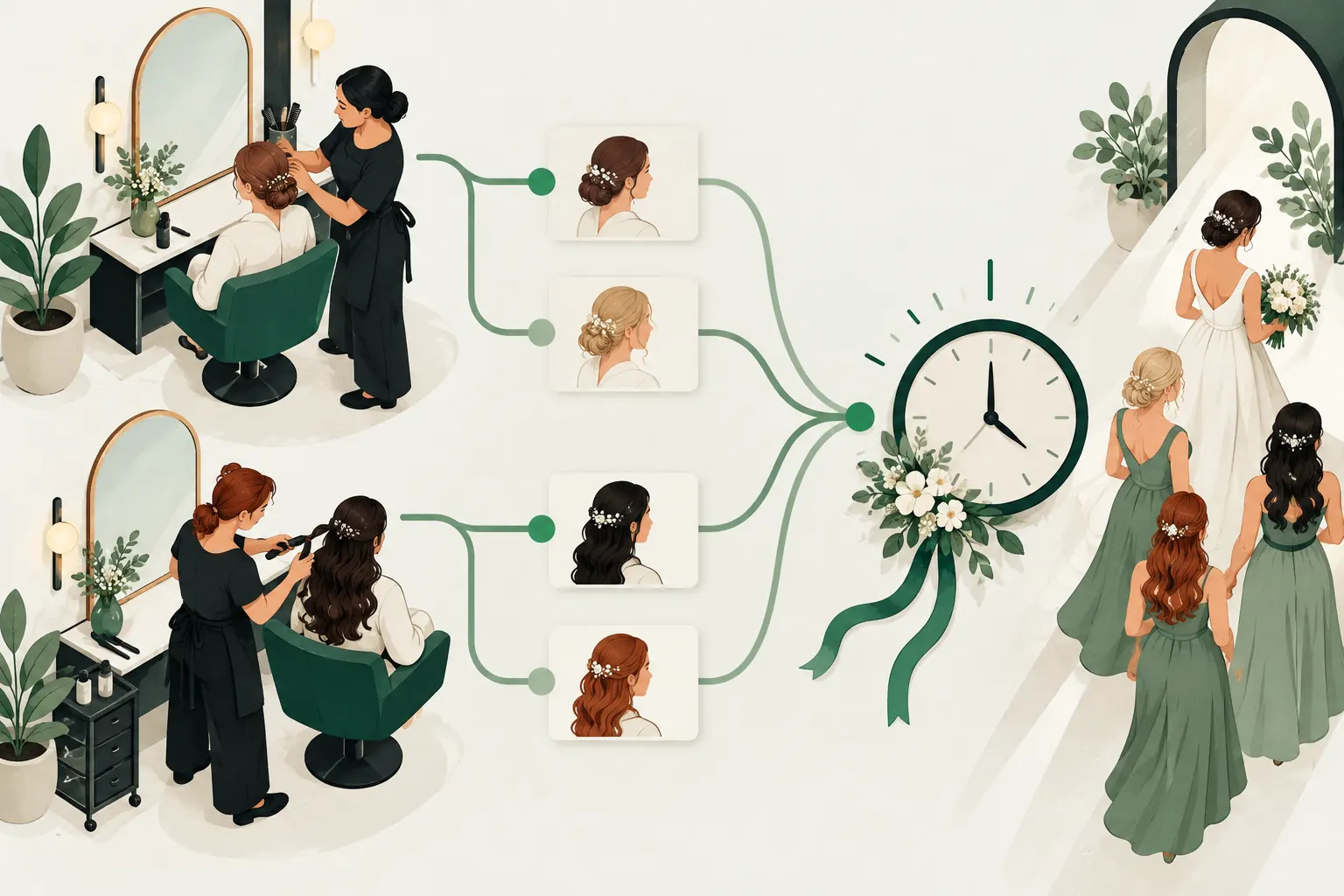
A salon group booking schedule needs a named service, an assigned stylist, an arrival time, and a finish time for every guest. For a bridal party with one shared departure deadline, start with that deadline and work backward. Then check each stylist and station separately before promising that the whole group can be ready.
Four people arriving together do not create four available chairs. All times below are planning examples; use your own service durations.
Define what the group needs
Before reserving the morning, ask whether the group wants to arrive together, receive services together, or leave together. Those are different requests. A party may happily use staggered arrivals if everyone is ready for the same taxi. Another group may value the shared experience enough to accept a longer visit.
Record the departure deadline as an actual clock time. If photographs begin at 13:00 elsewhere, ask when the party must leave your premises. Do not silently treat the photography time as your service completion time. Let the organizer confirm their travel allowance rather than estimating it on their behalf.
Name one contact who can approve the group plan. Individual guests still need to approve their own services and relevant personal details, but one coordinator prevents several conflicting versions of the schedule from circulating.
Collect one row per guest
Use a small planning sheet with these fields:
- Guest name and a contact route for their own appointment information.
- Exact service and any agreed add-ons.
- Estimated service duration, checked by the assigned professional.
- Qualified stylist and required station or equipment.
- Arrival time, service start, and planned finish.
- Any dependency, such as a separately booked makeup visit.
- Payment responsibility and confirmation status.
Avoid entries such as "bridesmaid three, same as everyone." A guest who needs a longer consultation or a different finish can change the entire sequence. Resolve those differences before the schedule becomes a promise.
Calculate the workload before drawing the timetable
Add up the service minutes and reset minutes for each stylist. Compare that workload with the time available before the finish deadline. Then check whether the right professional, station, and guest are free at each stage.
Suppose a party needs one 60-minute service and three 45-minute services. That is 195 service minutes. If two stylists can each work for two hours, there are 240 gross staff minutes. The remaining 45 minutes must also accommodate any required resets, preparations, and agreed contingency. It is not automatically sellable space.
Now test the skills. If only one stylist can perform the 60-minute service, assign that service first. If both stylists need one shared basin, check the basin's actual occupied intervals. Do not assume that separate staff columns eliminate a shared-resource conflict. Our guide to shared equipment scheduling explains that separate check.
Build the schedule backward from the finish deadline
Set a service completion deadline before the departure time, with an explicitly chosen allowance for checkout, gathering belongings, and any agreed final checks. Keep that allowance visible. Otherwise the last service tends to consume it without anyone noticing.
For this fictional example, four guests must leave at 12:30. The salon chooses 12:00 as the service completion deadline and keeps 12:00 to 12:30 for agreed final checks, payment, and departure. Two qualified stylists each have an appropriate station. Each gap between their guests includes a 15-minute reset allowance.
| Stylist | Guest | Service window | Reset or remaining time |
|---|---|---|---|
| A | Maya | 10:00 to 11:00 | Reset 11:00 to 11:15 |
| A | Noor | 11:15 to 12:00 | Services complete at 12:00 |
| B | Ella | 10:15 to 11:00 | Reset 11:00 to 11:15 |
| B | Ruth | 11:15 to 12:00 | Services complete at 12:00 |
The table contains 195 service minutes and 30 reset minutes. It schedules the longest service first, gives each guest a named slot, and ends both working sequences by 12:00. It assumes no additional shared-resource conflict; if that assumption is false, redraw the plan.
Use the reset time your service and station require; the 15-minute allowance is an example. See room turnover time between studio appointments for a method of measuring that interval.
Add arrival times after service times
If your team chooses a 15-minute check-in allowance for this example, Maya arrives at 09:45, Ella at 10:00, and Noor and Ruth at 11:00. Those are arrival times, not additional services. The two later guests can arrive earlier only if the salon has agreed that it can host them comfortably.
Give the organizer both arrival and service times so they can explain the staggered starts. Reception should keep the assigned order when a guest arrives early.
Protect the rest of the salon day
Check the group plan against existing individual bookings, staff breaks, and opening duties. Include unrelated clients' appointments in the calculation. If a stylist has another booking at 12:15, establish whether they have any role in the group's final checks before offering that time.
Mark tentative capacity with an expiry time. For example, the salon might hold the proposed slots until 17:00 tomorrow while waiting for confirmed services. The actual hold period is your business choice. Tell the organizer what is held, when it expires, and what is needed to confirm it.
Keep the group linked by a common reference while retaining each guest's real service and staff allocation. You can do this in your existing calendar and planning sheet. Do not rely on a single anonymous block that hides which professional is occupied or who needs to arrive next.
Confirm services, money, and changes in separate lines
Operational confirmation needs more than "Saturday is booked." Send the guest list, service choices, arrival times, finish deadline, and departure plan. Ask the organizer to check names and timings, and ask each guest to resolve any individual service question with the salon.
Explain payment responsibility in a separate section. Identify whether one organizer pays the group total or each guest pays their own agreed amount. If you use a deposit, state how it is allocated and how changes are handled under your existing published terms. Do not invent a different rule at checkout because the group arrived together.
Set a service-change cutoff that gives the team time to reassess capacity. A request received before the cutoff still needs approval if it changes duration or resources. A request received afterward should never be treated as automatically possible. The service add-on duration guide provides a useful check for that decision.
Example confirmation message
Your group is planned to finish services by 12:00 and leave by 12:30. Maya: arrive 09:45, service 10:00. Ella: arrive 10:00, service 10:15. Noor and Ruth: arrive 11:00, services 11:15. Please check the attached service list and payment responsibilities. Send requested service changes by the agreed cutoff; we will confirm whether the revised plan fits. An early arrival does not change the assigned service start.
Adapt this message to your real services, timings, and terms. Send each guest only the personal information they need; keep sensitive consultation details out of a shared group chat.
Decide how to handle delays before the party arrives
A late guest can delay the next guest with the same stylist. Give the front desk a decision route: identify the affected stylist, calculate the remaining time before the deadline, and ask the professional whether the agreed service can still be completed appropriately.
Moving another guest forward can work only if that guest is present, prepared, and suitable for the available professional and station. Confirm the revised order with everyone affected. Do not swap names in the calendar while leaving the original arrival messages unchanged.
If the original service no longer fits, offer a professionally appropriate alternative only with the guest's agreement, or explain that the service needs a different slot. Never recover time by skipping required preparation or cleaning. Apply your existing late-arrival policy consistently and explain the effect on the group deadline.
The same process applies to an extra guest. Treat the request as new workload with its own service, professional, station, and finish time. A spare waiting chair does not prove that another service fits.
Give the team a brief day-of checklist
Before the first guest arrives, review the latest confirmed version together. Check the four names, service durations, staff assignments, station readiness, payment plan, and contact person. Make sure any separate makeup or photography appointments are reflected in the relevant guest's timing.
Assign one person to communicate schedule changes. Stylists should report a likely overrun when it becomes visible, not after the next guest's start time has passed. Reception can then update the organizer using an agreed plan instead of making promises from an incomplete picture.
At checkout, reconcile the services delivered against the confirmed service list. Record who paid each amount and any approved change. Do not charge the same add-on once to a guest and again to the organizer because the group reference appears on both records.
Review the plan after the booking
Compare planned and actual start and finish times for each guest. Note whether a delay came from an inaccurate duration, a late arrival, a shared station, or a service change. Those causes need different fixes; a larger blanket buffer may hide the source of the delay.
Keep a reusable template, but copy its structure rather than its timings. The next party may have different skills, services, or departure constraints. Check staffing and timings again for each party.
About this article
Skedful is responsible for this blog. Our publishing workflow uses AI assistance to prepare English and Hebrew drafts and generate illustrations.
Worked examples and sample calculations describe hypothetical scenarios. When an article cites research or customer results, follow the source for its context and limits.
Found an error? Send us the article link and the passage that needs a correction.
Report an error to SkedfulReminders come with every Skedful plan, on a schedule you set once. PricingSkedful vs Fresha vs Booksy