Short gaps between salon appointments: check what fits
Manage short gaps between salon appointments with a practical service-fit check, examples for 15, 30 and 45 minutes, and clear rules for protected time.
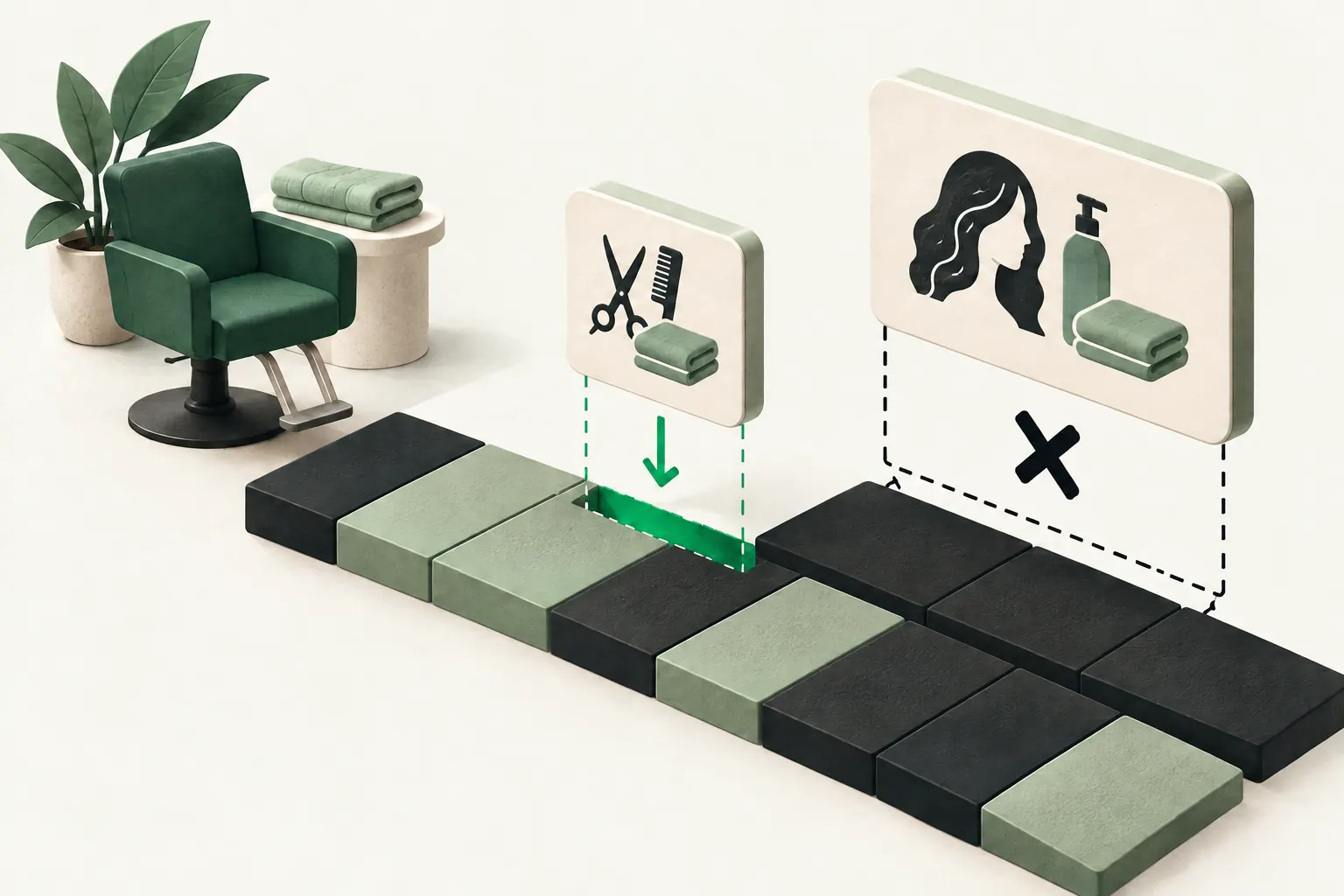
Short gaps between salon appointments can leave little room for another complete booking. A 25-minute opening might fit one service, fail to fit another, or already belong to cleanup and a planned break. Check whether a complete booking can fit before the next client.
The same checks apply to barbers, beauty studios, photographers, trainers and other businesses that reserve time for clients. All timings below are illustrative; use your own measured service times.
Check what each opening is for
An uncoloured section of a calendar is only a visual signal. Before offering it, check the person, room and equipment that the proposed service needs. A stylist might be free while the basin is occupied. A coach might have no client booked but still need preparation time before the next session.
Give each opening one of four labels:
- Bookable: a complete service and its supporting work fit with the required resources.
- Protected: the time belongs to a break, preparation, cleanup or another planned commitment.
- Conditional: a booking could fit after a specific change that has not yet been agreed.
- Too short: the remaining window cannot accommodate any appropriate service on your menu.
This classification prevents the front desk from promising time that the service team cannot deliver. Make the label visible in whatever shared planning method you use. A brief note is enough if everyone knows what it means and who may change it.
Keep staff breaks protected even when they appear between two appointments. Follow your agreed staffing arrangements and applicable requirements.
Calculate the full footprint of the proposed booking
Start with the actual boundaries of the gap. If the previous service finishes at 11:10 and the next begins at 11:40, the calendar window is 30 minutes. Then account for any work that still needs to happen inside that window.
Use this check:
Required time = preparation + consultation or check-in + service delivery + checkout or notes + reset.
Compare that total with the time genuinely available after existing commitments. Count each task once. If checkout is already included in your measured service duration, do not add it again. If the previous booking has a reset block ending at 11:15, use 11:15 as the new booking's earliest start rather than subtracting the reset twice.
For an illustrative 30-minute window, suppose a short service needs 3 minutes of setup, 2 minutes of check-in, 15 minutes of delivery, 3 minutes of checkout and 5 minutes of reset. Its complete footprint is 28 minutes. That leaves only 2 minutes of slack. Whether that is sensible depends on how predictable the work is and whether every resource is available.
A service advertised as 20 minutes can therefore fail to fit a 25-minute opening. Check the supporting work as well as the advertised treatment length. For a separate method of measuring transitions, see our guide to room turnover time between appointments.
Build a small service-fit list for the front desk
Do not make reception invent a service every time a short gap appears. Create a short list of existing services that can sometimes use these windows. Record the normal footprint, qualified staff, resources and conditions for each one.
Include the conditions for each service. An example entry might read: “Fringe maintenance: returning clients only, measured footprint 20 minutes, qualified stylist and chair required, no additional styling.” These conditions are part of the offer. They should never be hidden until the client arrives.
For a 15-minute opening, check protected tasks first. The window may be useful for returning a call, preparing the next consultation or completing notes. It might fit a very short service if your own measurements support that, but a short-looking service is not automatically a safe fit.
For a 30-minute opening, use the footprint calculation and the service-fit list. A returning client's clearly defined maintenance service may be more predictable than a first visit with an unknown consultation requirement. Confirm the scope before offering the time.
A 45-minute opening may fit more services. Check whether the booking would occupy a resource needed by the following appointment. Also consider whether joining it to an adjacent unbooked period could preserve a useful longer opening.
Use your own service timings when assessing these windows. A photographer's equipment setup or a beauty studio's reset process may use most of the available window.
Avoid creating the next awkward gap
Some fragments come from cancellations. Others come from the way start times are offered. Examine the second group before spending effort on repeated last-minute outreach.
Imagine a hypothetical studio with a free period from 10:00 to 12:00. A service has a complete 45-minute footprint. Booking it at 10:20 leaves 20 minutes before it and 55 minutes after it. Booking at 10:00 leaves one continuous 75-minute opening. The service consumes the same amount of time, but the remaining availability has a different shape.
When a client has flexibility, offer suitable times near the beginning or end of a free block. Explain the choices clearly and allow the client to select. Do not silently move an existing appointment to improve the calendar.
If your booking tools offer controls for start times or gap handling, check how they behave with your actual service durations and buffers before changing them. Test a short service, a long service and a service with an add-on. A setting that looks helpful in one example can remove useful choices in another.
Keep this experiment separate from shortening service times. The purpose is to offer more coherent availability while preserving the work required. Our guide to appointment length for services with add-ons explains how to measure those combinations.
Offer a short opening without creating confusion
Use targeted, permission-based communication through channels you are entitled to use. An appropriate offer identifies the exact service, start time, scope and price or price basis. It also explains how the booking becomes confirmed.
For example:
“We have a 30-minute opening tomorrow at 11:10 for your usual fringe maintenance with Maya. It includes the agreed trim and checkout; additional styling would need a longer visit. Would you like us to confirm it at the usual price?”
Only offer services the team can deliver properly within the available footprint. If the client requests an extra, recalculate the booking before agreeing.
When contacting more than one person, avoid promising the same opening repeatedly. Follow your normal confirmation process and any hold expiry you have clearly communicated. A reply expressing interest should not be mistaken for a confirmed booking if further steps are required.
Discounts are optional. First establish that the offer is useful and the timing works. A reduced price does not make an unsuitable service fit, and repeatedly discounting every fragment can complicate the expectations you set with clients.
Give unbookable time a deliberate purpose
Sometimes leaving a gap unbooked is the right decision. Keep a small list of useful tasks that can be paused safely when the next client arrives: reviewing tomorrow's preparation needs, checking stock, updating notes or sending a promised follow-up.
Do not use this list to absorb every break. Distinguish available work time from protected rest time. Also avoid starting a task with a hard external deadline or a long uninterrupted setup unless the window supports it.
If a conditional opening depends on moving another client, ask that client first and accept a refusal. Until the change is agreed, the opening stays conditional. Never sell a time slot based on the assumption that someone else will accommodate it.
Review the pattern for two weeks
Choose a manageable observation period and record short gaps at the same point each day. For each one, note its length, cause, classification, proposed use and actual outcome. Do not enter sensitive client details in a separate worksheet when a booking reference will do.
Useful review questions include:
- Which fragments were created when the initial booking was accepted?
- Which appeared after cancellations or changes?
- Which were protected work incorrectly treated as spare capacity?
- Which services fitted without overrunning or borrowing reset time?
- Which offers were declined because the service or timing was unsuitable?
Keep your measures simple. Count genuine bookable fragments separately from breaks and reset blocks. Record whether filled gaps finished on time. A calendar that looks fuller is not an improvement if the following clients wait longer.
Change one booking habit at a time, such as offering edge-aligned starts when clients are flexible. Compare the resulting pattern before expanding the change. Do not infer a revenue increase from fewer visible gaps without checking actual completed services, costs and staff workload.
Treatwell's buffer-time documentation describes preparation and cleanup as reasons to reserve time around services. Label those buffers in your calendar so reception can distinguish them from time available for bookings.
About this article
Skedful is responsible for this blog. Our publishing workflow uses AI assistance to prepare English and Hebrew drafts and generate illustrations.
Worked examples and sample calculations describe hypothetical scenarios. When an article cites research or customer results, follow the source for its context and limits.
Found an error? Send us the article link and the passage that needs a correction.
Report an error to SkedfulReminders come with every Skedful plan, on a schedule you set once. PricingSkedful vs Fresha vs Booksy