Event Ticket Types: Early Bird, Standard and Guest Places
Plan event ticket types with a 40-place worksheet for early bird, standard and guest admissions. Set quantities, sales conditions and controlled reallocation rules.
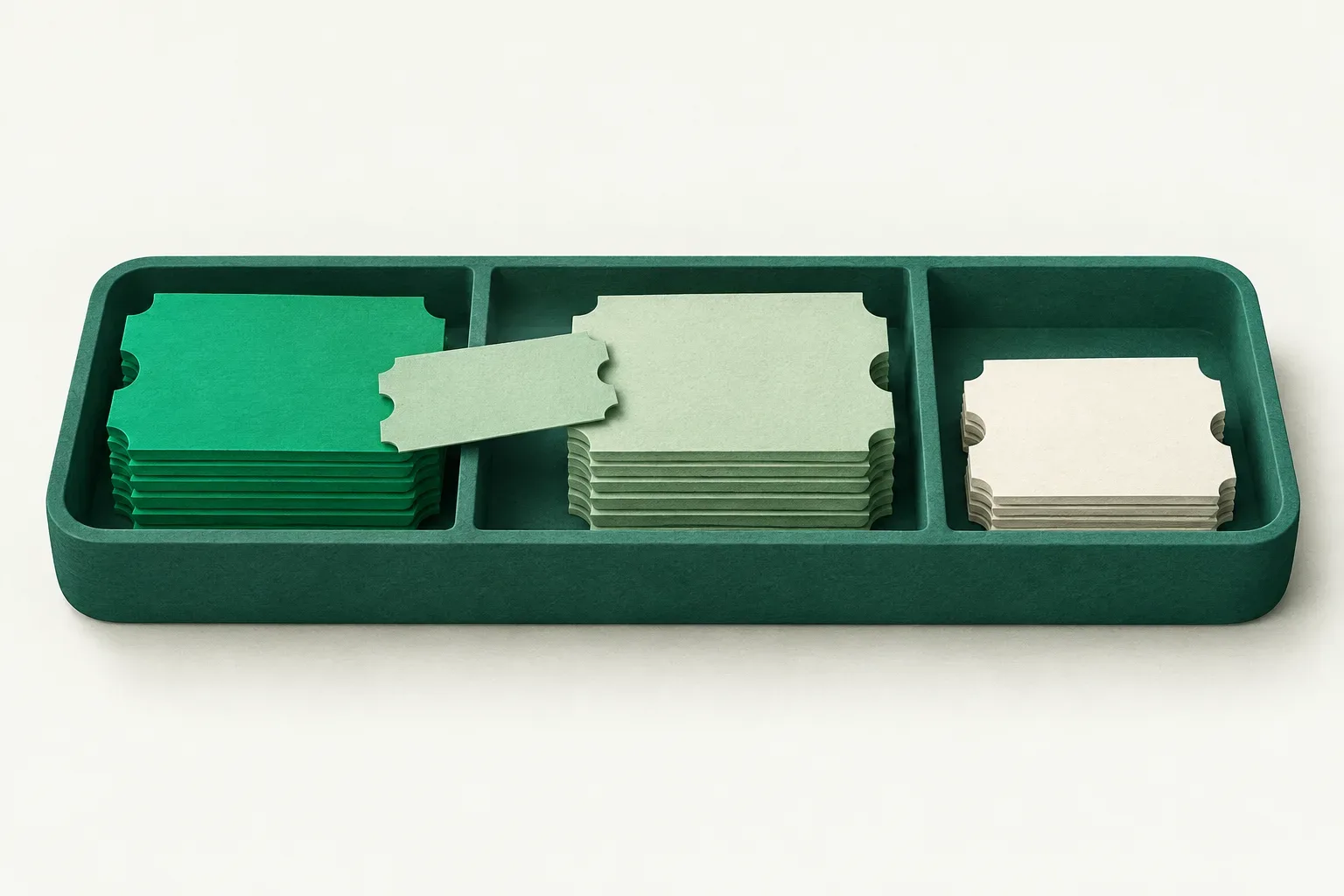
Event ticket types divide the places at one event into offers with clear prices, inclusions and sales conditions. Start with the total participant limit, then assign every early bird, standard and guest place within it. Adding a ticket type must not quietly add more people to the room.
For a small workshop, masterclass or performance, a short allocation sheet can keep those decisions visible. The fictional 40-place workshop below includes a change of allocation when early sales close with tickets still available. If you are preparing the whole event, use the workshop ticket sales checklist alongside this sheet.
Define what each ticket admits someone to
Write the admission entitlement before naming the ticket. In the example below, each ticket admits one participant to the same two-hour workshop, with the same materials and instruction. The early bird offer changes the price and purchase conditions; the session and workstation are the same.
Use names a buyer can understand without asking the organizer. “Early bird” needs a quantity or closing rule. “Standard” needs a clear description of what is included. A guest allocation needs an owner who decides who receives it. Labels such as “VIP” need a real additional benefit that the organizer can deliver, so leave them out when everyone receives the same experience.
Count admissions separately from orders. A customer who buys three single-person tickets uses three participant places, even if there is one payment and one order reference. For this worksheet, every ticket covers one person. If you later introduce a pair or group offer, define the number of people it covers and verify how your provider counts them before selling it.
Set the event limit before dividing the tickets
Confirm the participant limit with the venue and the people delivering the activity. Check the actual room arrangement, workstations, equipment and instruction plan. A room that holds forty seated listeners may support fewer people doing a practical activity. Record the agreed limit for this particular event rather than copying the building's headline capacity.
The example assumes forty participant places have been approved. Staff and other people on site still need to be included in the venue's separate occupancy planning. The forty places here describe the participant allocation only.
An event limit and a ticket-type quantity are separate controls. Ticket Tailor's ticket-type documentation describes individual prices and quantities, plus group limits across types. Check how your own provider combines event limits, type limits and active reservations; a spreadsheet total cannot enforce checkout capacity.
Staff time needs its own schedule. A two-hour event for forty people does not create eighty bookable staff hours. Use the staff capacity worksheet if the same team also serves individual clients that day.
Copy this 40-place ticket allocation worksheet
Create one row per offer. Record the event name, date, participant limit, person responsible and last revision above the table. Keep the unit clear: every quantity below is a number of people admitted.
| Ticket type | Places | What is included | Sales or allocation condition |
|---|---|---|---|
| Early bird | 10 | One participant, workshop and materials | Up to 10 tickets; closes at the stated deadline or when allocated |
| Standard | 26 | The same workshop and materials | Available within the stated sales window and remaining capacity |
| Invited guest | 4 | The same workshop and materials | Organizer approval; no payment requested |
| Total | 40 | Forty participant places | All three types share the event limit |
For this fictional plan, the early bird face value is 150 currency units and the standard face value is 180. Guest admission is complimentary. The organizer in this example sets both prices. Show the actual currency, inclusions and buyer total in the real offer.
Keep a second set of figures beside each row: issued admissions, active payment reservations and places still unallocated. A quantity of ten early bird tickets is a ceiling for that offer. It does not mean ten people have already registered.
Planned allocations, current commitments and actual arrivals answer different questions. Keep them in separate columns so the door team does not interpret the sales plan as an attendance list.
Give early bird tickets a precise closing rule
Choose the quantity, deadline and time zone before promotion starts. For example: “Ten early bird places at 150 currency units each, available until 8 November at 18:00 Jerusalem time, or until all ten are allocated, whichever happens first.” The workshop itself could be on 21 November. The purchase deadline and event date need separate fields.
Decide what happens to a payment reservation started before the deadline. Ask the provider whether it keeps the original price, how long it remains active and what happens if payment finishes later. Publish terms that match the supported behavior. Do not promise that a buyer can retain a price merely by opening the page.
Ticket Tailor's tiered-pricing guide documents a provider-specific way to release a later type when an earlier one runs low. That behavior needs verification in the service you choose. If you make the change manually, assign a person and a time to close the old offer, check live reservations and open the next allocation.
Avoid restarting an advertised limited offer repeatedly while leaving the original scarcity message in place. If you change the deadline or quantity, update the public offer and record the change. Existing buyers should still receive the admission and price they purchased under the applicable terms.
Keep invited guests inside the same limit
Four guest places leave thirty-six places for paid admissions in this plan. Keep those four unavailable for general sale until the organizer either assigns or deliberately releases them. An informal promise to “bring a few friends” needs a number before it becomes an invitation.
Name the person who approves guests and a deadline for unused allocations. Record each issued guest admission through the provider's supported process so it appears in the participant count and entrance records. A private organizer-controlled allocation and a public free ticket offer have different audiences; verify the access controls before sharing a link.
The Hebrew MyVisito organizer guide describes distinct ticket types and invitation handling within its own service. Whatever tool you choose, check whether a guest issuance consumes the intended allocation and whether an invitation still needs acceptance or approval. Check that a valid admission has been issued after the invitation is accepted or approved.
Reallocate unsold places without doubling them
Suppose the early bird deadline arrives with six early admissions issued and one place still held by an active payment reservation. Standard sales have eighteen admissions issued and two active reservations. Three guest admissions have been issued, leaving one guest place unassigned.
The commitments are twenty-seven issued admissions plus three active reservations. That leaves ten places unallocated: three early bird, six standard and one guest. Only nine of those places belong to the public paid allocations; the remaining guest place is still protected.
To move the three unallocated early places into standard sales, use the provider's supported change process. Prevent purchases from using those places while the change is underway. Read current quantities and reservations again, reduce the early allocation from ten to seven, then increase standard from twenty-six to twenty-nine. Keep guests at four. The new allocation still totals forty: 7 + 29 + 4 = 40.
Leave the active early reservation intact under its existing terms. If it expires later, verify that it no longer carries a place before considering another reallocation. Never reduce a type below its current issued admissions and active commitments. Do not create a fresh block of ten standard tickets while leaving the old early allocation available.
Record who changed the allocation, when, the old and new quantities and the reason. If the provider cannot support the required change safely, keep the original allocation and ask for its documented alternative.
Test the last place across different ticket types
Use the provider's supported test environment or controlled test procedure before opening sales. Check the event limit as well as each type limit. A successful early bird purchase should use the same shared capacity as a standard or complimentary admission.
Test a three-ticket order, the last place in one type and the last place in the event. Check what buyers see when a type sells out but another remains available. Verify whether a guest allocation is actually protected when standard tickets are selling quickly.
Also rehearse a reservation expiry and a cancellation. Check when capacity becomes available in the chosen service; do not automatically add every cancelled ticket back to the sheet. Confirm that the original admission can no longer be used before following the provider's supported release process. For entrance handling, give the operator the QR ticket check-in checklist.
Before launch, have a colleague read the ticket choices on a phone and explain what one purchase includes, how many people it admits and when the price changes. Correct any ambiguity in the actual offer. If you want to manage the event with Skedful, contact the team with the date, country, participant limit and proposed ticket types to confirm current availability and fit.
About this article
Skedful is responsible for this blog.
Worked examples and sample calculations describe hypothetical scenarios. When an article cites research or customer results, follow the source for its context and limits.
Found an error? Send us the article link and the passage that needs a correction.
Report an error to SkedfulReminders come with every Skedful plan, on a schedule you set once. PricingSkedful vs Fresha vs Booksy