Salon walk-in policy: protect booked clients and welcome new ones
Build a salon walk-in policy with a four-part capacity check, a worked timing example, reception scripts, and a practical template.
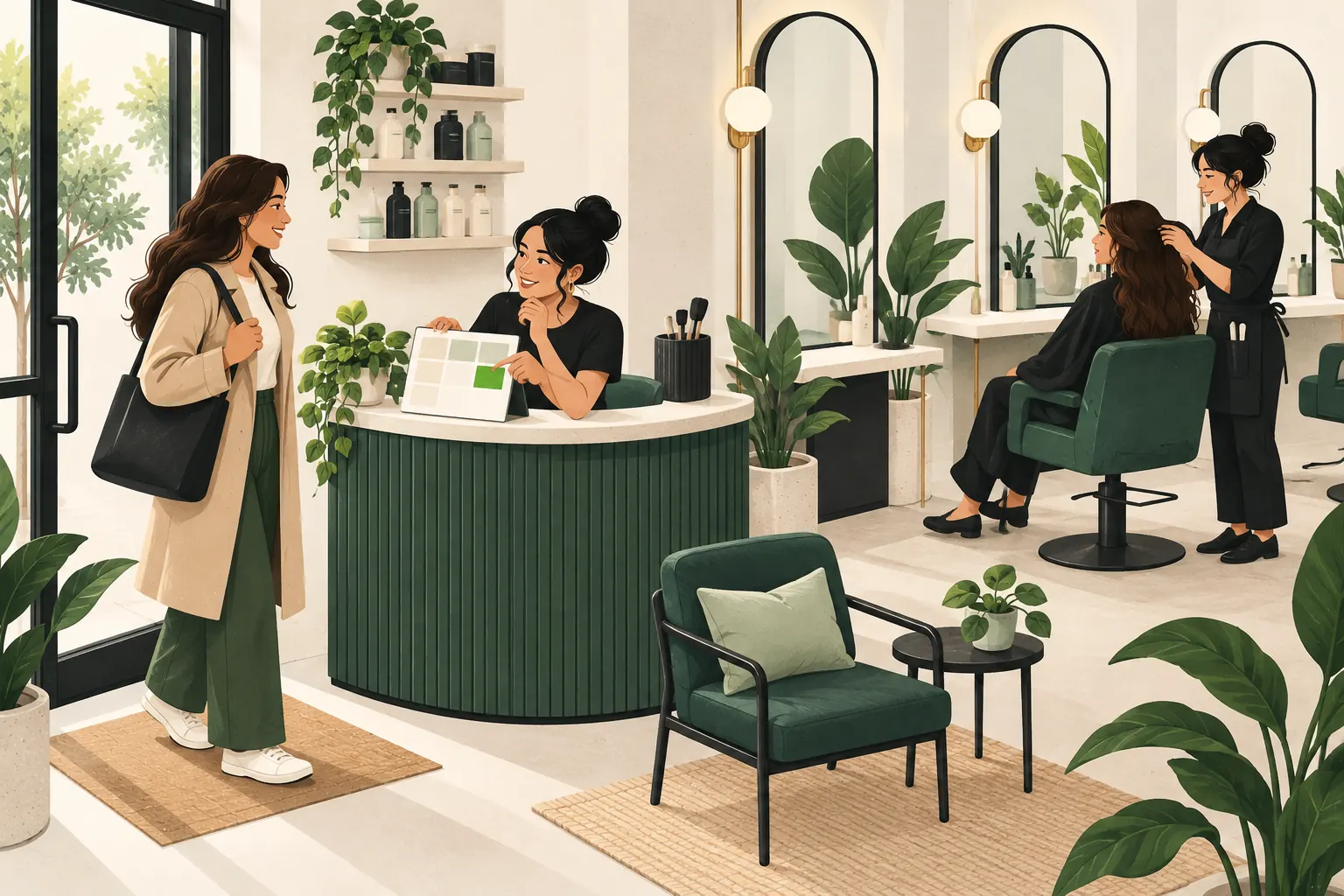
A salon walk-in policy should let reception check whether a requested service fits before the next booked client. A free chair is only one part of the answer. You also need a suitable team member, the full service window, any shared equipment, and time to prepare for the next client.
The times below are planning examples; use your own measured service, checkout, and reset times.
Decide which services to accept without a booking
Start with a short list of services that your team can assess and deliver reliably on the day. A barber might include a standard cut or beard tidy. A nail studio might accept a simple repair after checking its scope. A photography studio might offer a short consultation while keeping a full shoot appointment-only.
Do not describe every service as available just because someone is present at reception. A consultation, preparation requirement, specialist skill, or uncertain service duration may make a request unsuitable for immediate acceptance.
Create three categories:
- Available for a capacity check: defined services with a known scope.
- Consultation first: requests that need assessment before a duration can be agreed.
- Advance booking required: work that needs preparation, a particular specialist, or a longer uninterrupted session.
Give reception a plain-language explanation for each category. This keeps the answer consistent when the owner is busy.
Choose one capacity model for each shift
Shared availability between booked visits
Walk-ins use genuine openings in the same diary as advance bookings. Every accepted visit is recorded before service starts. This can suit a small team with uneven demand, provided someone owns the availability check.
The main risk is treating every visible gap as usable. Check the entire service footprint, including preparation, checkout, and reset. Our guide to setting appointment length for service add-ons explains why a short extra request can change the finish time.
A defined walk-in window
Reserve a specific period for selected same-day services. Tell clients which hours apply and when reception stops accepting requests. If the window is unused, decide in advance whether and when it can be released for bookings.
For example, a studio could trial a one-hour afternoon window on two quieter weekdays. Measure the trial before committing to those hours.
A designated team member
One person takes walk-in requests while others work from bookings. This only works when that person's skills and resources match the advertised services. A general walk-in sign should not imply that every specialist is available.
Keep the chosen model visible at the morning handover. If staff availability changes, update the policy for that shift before accepting new clients.
Use a four-part check before saying yes
Check these four conditions together:
- Service: the requested work and any additions are clearly agreed.
- Person: a qualified team member is available for every stage they must perform.
- Resources: the chair, room, basin, equipment, and preparation area are available when needed.
- Time: the whole visit can finish, including reset, before the next protected commitment.
If one condition fails, offer a later start, a different agreed service, or an advance booking. Do not quietly borrow time from the next client.
The earliest feasible start plus the time for the complete visit must fall at or before the next protected commitment. For multi-stage work, check each person's and resource's timeline separately. An overall finish time alone does not prove that the basin is available halfway through.
Worked example: an empty chair at 14:10
Consider an illustrative salon where a walk-in arrives at 14:10. The suitable stylist has a confirmed client at 15:00. Reception estimates five minutes to confirm the scope and prepare, 30 minutes for the service, five minutes for checkout, and ten minutes to reset.
| Stage | Planned window |
|---|---|
| Agree service and prepare | 14:10 to 14:15 |
| Deliver service | 14:15 to 14:45 |
| Checkout | 14:45 to 14:50 |
| Reset | 14:50 to 15:00 |
| Next booked client | 15:00 |
The visit fits exactly on paper, with no time for a delay. If the service estimate is uncertain, the stylist is finishing late, or reception needs longer to assess the request, the next client may have to wait. Choose a shorter agreed service only if it is appropriate and the client wants it, or offer another time.
Now suppose the client requests an additional 15-minute treatment. The revised finish becomes 15:15. The answer changes even though the chair was empty on arrival. The next client keeps the 15:00 commitment.
For shared spaces, use the separate room turnover planning method and shared equipment scheduling check.
Tell waiting clients what has been confirmed
Separate three states: requesting service, waiting for an availability decision, and accepted for a specific start window. A name on a queue does not automatically mean a service has been booked.
At check-in, explain the requested service, the estimate of when a decision can be made, and whether the client may leave while waiting. If you offer a return window, agree how reception will contact them and what happens if they do not respond.
Avoid a precise wait estimate when it depends on unfinished work with an uncertain duration. A useful message is: "We expect to review availability around 14:30. We have not reserved a start time yet. Would you prefer to wait for an update or choose a confirmed booking?"
Collect only the details needed to manage that visit and contact the client as agreed. Waiting for service should not silently enrol someone in marketing.
Keep one owner for the final acceptance
Assign the reception lead or shift lead to confirm each walk-in. Team members can suggest availability, but the designated person checks the shared diary and records the commitment.
The acceptance record should include the service, team member, start and finish window, required resources, agreed price or estimate, and any specific scope limits. Use the same operational record as other visits so colleagues do not have to reconcile a paper queue with an invisible promise.
If two people are taking enquiries at once, recheck availability immediately before confirming. One opening cannot be promised to both an online booking and a person standing at reception.
A salon walk-in policy template to adapt
Use this as an operational starting point and replace the brackets with decisions your studio can support:
We welcome walk-in requests for [services] during [hours], subject to team and resource availability. Existing bookings keep their reserved times. Reception will confirm the service, price or estimate, and start window before accepting your visit. Joining the waiting list does not reserve a service time. If we cannot fit the full visit safely into today's availability, we will offer another suitable option. Please tell us before adding services so we can check the time again.
If clients can leave while waiting, add:
If you leave the studio, we will contact you by [agreed channel]. We can hold an offered start until [specific time]; reception will explain this when making the offer.
Display the same practical message at the entrance, on your contact page, and in reception's answers. State any last-acceptance time clearly. A closing time is not a promise that a long service can begin just before it.
Reception scripts for awkward moments
When a client asks why an empty chair is unavailable:
"That chair has a booking at 15:00, and we need to finish and prepare before then. Your requested service needs more time than the opening allows. I can check a later slot or another suitable team member."
When the client asks for an extra service:
"We agreed a cut that finishes by 14:45. Adding that treatment changes the time we need. Let me check availability before we confirm the addition."
When the waiting estimate changes:
"The current service is taking longer than expected. We cannot confirm the start window we discussed. Your options are to wait for another update, take this later booking, or leave the request with us for another day."
Keep the explanation factual and give choices. Avoid blaming the booked client, another team member, or the person who requested the additional work.
Handle exceptions without changing the rule silently
Late arrivals, staff absence, and a temporarily unavailable room can all reduce today's capacity. Recalculate it before accepting more walk-ins. Do not treat an absent booked client as a released opening until your studio's stated policy allows that decision.
When a client has a specific communication or access need, discuss practical arrangements with them. Do not infer urgency, service duration, or preferred support from appearance. Keep professional service and preparation requirements intact when discussing alternatives.
If the team needs a wider operational response, use a separate same-day staff absence cover plan. A walk-in rule cannot substitute for a staffing decision.
Review the policy using a small shift log
For a two-week trial, record walk-in requests, accepted visits, requests offered another time, actual start and finish times, and whether a booked client started late because of a walk-in. Note the reason for each refusal, such as specialist availability, insufficient time, or a shared resource conflict.
Check whether the advertised window attracts requests your team cannot deliver. Are estimates consistently shorter than actual visits? Does reserved walk-in time stay unused while advance bookings are refused?
Change one decision at a time, such as eligible services or the release time for unused capacity. Compare similar shifts before deciding whether the change helped. Do not turn a single busy Saturday into a permanent staffing rule.
Diesel Barbershop's published appointment policy gives clients both options, stating that most locations accept bookings and walk-ins. Your policy should explain the options your own team can offer.
About this article
Skedful is responsible for this blog. Our publishing workflow uses AI assistance to prepare English and Hebrew drafts and generate illustrations.
Worked examples and sample calculations describe hypothetical scenarios. When an article cites research or customer results, follow the source for its context and limits.
Found an error? Send us the article link and the passage that needs a correction.
Report an error to SkedfulReminders come with every Skedful plan, on a schedule you set once. PricingSkedful vs Fresha vs Booksy