General admission vs reserved seating for small events
Choose general admission vs reserved seating for a workshop, talk or small performance. Use a decision table, a 30-place example and sample buyer messages.
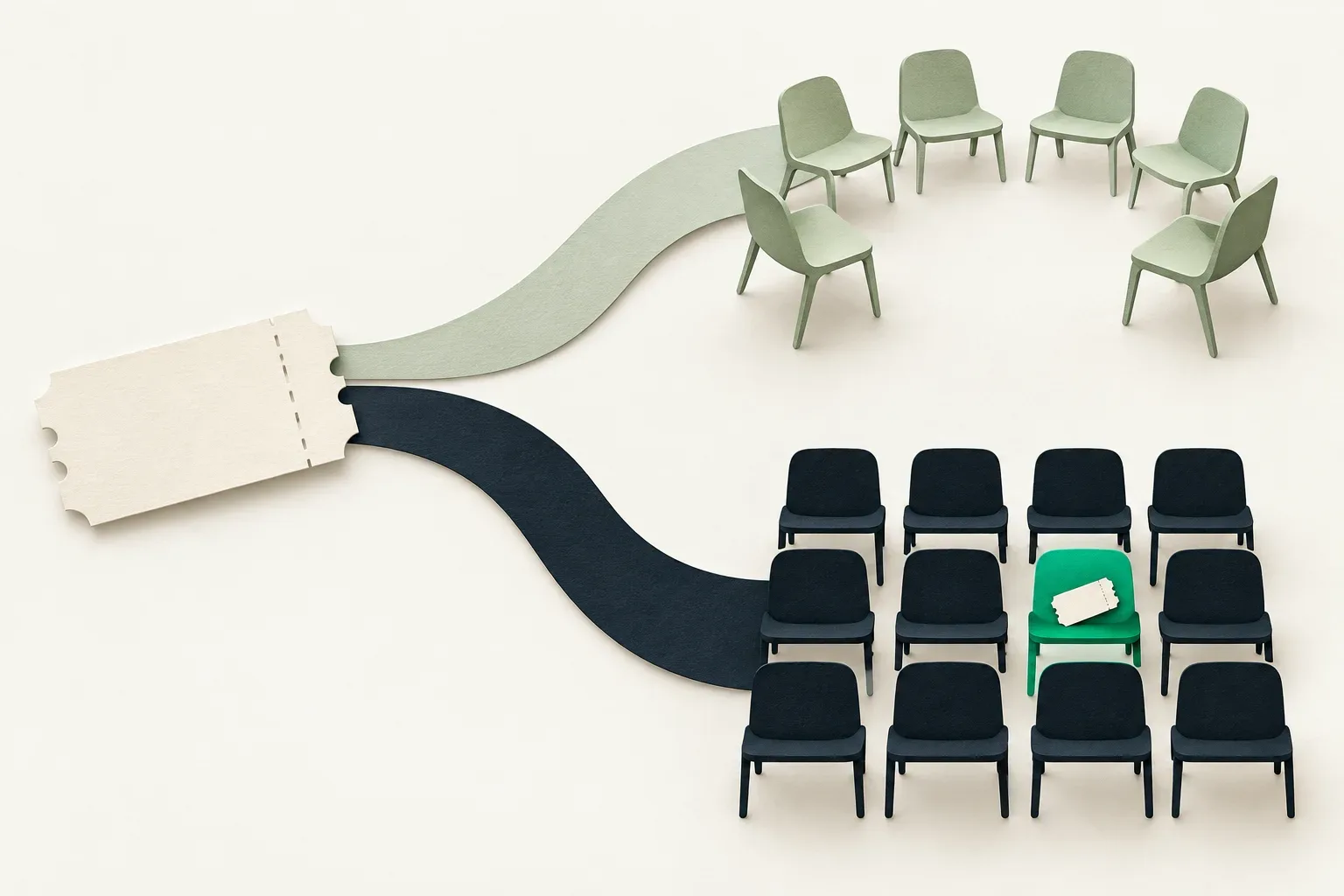
Choose general admission vs reserved seating while planning the room, before selling the first ticket. Specify whether each ticket identifies a particular seat or lets its holder choose an available place on arrival.
For a dated workshop, seated talk or small performance, the answer affects companions, sightlines and late arrivals. Use the decision table and fictional 30-place example below alongside the workshop ticket setup checklist.
Write the seating promise in one sentence
General admission gives access to an event or a defined area without assigning a particular seat. It can cover standing admission or unreserved seating, so the words “general admission” alone leave a seated-event buyer with questions. Say whether chairs are provided, whether every admission has a seat and how people choose one.
Reserved seating connects the admission to a specific place, such as row B, seat 4. Depending on the service and organizer's process, the buyer might choose that place or receive an assigned one. State which process applies. TicketSource's seating guide describes both models and the possibility of separate reserved and general admission areas.
Write down exactly what your event offers. “Unreserved seating, with one chair per admitted participant” is a different promise from “standing admission, with limited seating available.” A buyer choosing between those events needs that information before payment.
Price labels answer a separate question. An early bird ticket can buy either an assigned seat or unreserved admission. Use the ticket-type allocation worksheet for prices and quantities, then record the seating promise beside each offer.
Compare the room and activity before choosing
Set up the room as it will be used. Put out demonstration equipment, tables, speakers and any display. Walk from the entrance to the farthest participant position. Check the view from the sides and rear, including the view for someone who remains seated throughout.
For a practical workshop, test reach and working space as well as the number of chairs. A chair facing the demonstration may be useful for a talk but unsuitable for someone handling tools. Confirm the planned participant count and layout with the venue, including access routes and the other people who will be present.
Use this table to make the operational choice:
| Event | General admission can fit when | Reserved seating can fit when | Resolve before selling |
|---|---|---|---|
| Hands-on workshop | Workstations offer an equivalent activity and the instructor can allocate places on arrival | Particular stations have equipment or positions that must be assigned in advance | Whether a ticket promises a chair, a workstation or a named station |
| Seated talk | Views are reasonably comparable and people can choose available chairs on arrival | Buyers need known positions or the room has meaningful differences in sightlines | How companions sit together and how access arrangements are handled |
| Small performance | The format supports standing or clearly described unreserved seating | The audience expects a particular seat and positions affect the experience | Row and seat labels, late entry and help with seating disputes |
Event size alone does not determine the answer. A small room with a pillar may need more careful placement than a larger open room with a clear view.
Count usable participant positions in the chosen layout
Start from the layout you can deliver. Extra chairs stored in a cupboard do not automatically increase the event's usable capacity. Leave access routes clear and confirm changes with the venue before increasing sales.
Consider a fictional talk with an approved layout of thirty participant positions: twenty-eight chairs and two wheelchair positions. Two of the chairs sit next to the wheelchair positions for companions. The two wheelchair positions already belong to the thirty-place total.
For this organizer's planning record, four positions need coordinated allocation: the two wheelchair positions and the two adjacent companion chairs. Twenty-six other chairs remain. The layout is still thirty participant positions, with each allocation counted once. Staff and performers are handled separately in the venue's overall occupancy planning.
Under reserved seating, the room plan and ticket record must describe those actual positions accurately. Under unreserved seating, the door and room team still need to preserve any arrangements agreed with participants. Placing a “reserved” card on a chair does not add another place to the room.
The access allocation for another venue needs its own plan. Discuss the actual arrangements, ticket purchase route and companion needs with the venue and participants. Do not ask someone to publish personal access information in a public comment or shared attendee sheet.
Decide how companions and groups will sit
A four-ticket order tells you that four people have admission. Unreserved admission alone does not ensure four adjacent chairs remain when they arrive. If sitting together is part of the offer, define a process that can deliver it before using that promise in sales copy.
For unreserved seating, you might invite groups to arrive together and explain that adjacency depends on available places. If you instead agree to hold a specific group of chairs, record who owns that arrangement, which chairs it covers and how the room team will recognize it. Count those chairs within existing capacity.
For reserved seating, test a multi-ticket purchase through the chosen provider's supported test process. Confirm whether buyers can select adjacent seats, whether separated places are clearly shown and what the confirmation contains. Ask what happens when only isolated seats remain. Do not advertise “groups always sit together” based on a successful single-ticket test.
Give people a private route to request seating assistance. Ask what arrangement would help, confirm what the room can provide and tell them how to find the responsible person on arrival. Share only the details that person needs to carry out the arrangement.
Match the seating record to the physical room
If seats are assigned, use consistent section, row and seat labels on the room plan, confirmation and actual chairs. Walk the labels in person. Check that a person looking for B4 will find one unambiguous place, and that any reference diagram shows the stage or demonstration area in the right position.
Review the chosen service's handling of unavailable seats, incomplete purchases, changes and cancellations. One person editing a spreadsheet cannot assume it prevents another sales channel from selling the same place. Use the provider's documented inventory process and establish who may change assignments.
Takbull's event creation guide includes selecting a hall and configuring ticket quantities; its ticketing product page presents a seat map. Check the exact seating and purchase functions offered by the service you intend to use.
For unreserved seating, the floor team needs an accurate room count and a clear way to identify unavailable or agreed reserved positions. If you combine a reserved section with a general admission area, identify the boundary and each ticket's entitlement before checkout. Rehearse directing someone who approaches the wrong area.
Put seating instructions where buyers will see them
Use the same wording on the event page, ticket choice and confirmation. Adapt these examples to the actual layout and terms:
Unreserved seated event
“This is a seated event with unassigned chairs. Each admission includes one seat. Choose an available chair when you arrive. Doors open at 18:30; the talk starts at 19:00. Groups should arrive together; adjacent seats are subject to availability. Contact [event contact] privately for seating assistance.”
Assigned seats
“Your admission is for the section, row and seat shown in your confirmation. Check the details before completing your purchase. Doors open at 18:30. Show your ticket at entry, then ask the room team for help finding your seat if needed. Contact [event contact] for seating questions.”
Replace the placeholders and times, then read the message on a phone. If a buyer is told that seats are assigned, their confirmation must identify the assignment or explain the stated assignment process. Avoid describing a ticket as reserved while leaving the buyer to compete for a chair.
Rehearse late arrival and seating disputes
Before sales open, give the team three test situations: a group arriving after most chairs are occupied, someone requesting an agreed seating arrangement and a buyer looking for an assigned seat already occupied by another person. Name who investigates and who may approve a change.
Choose a late-entry process that suits the activity and venue. For a performance, a team member may need to guide late arrivals at a suitable pause. Publish the actual instruction. Do not quietly release an assigned seat because its holder has not arrived; follow the terms and process established for the event.
Admission checking and seating assistance have separate records to consult. A successful ticket check does not resolve a disputed seat assignment. Use the QR ticket check-in checklist for ticket exceptions, and keep the approved room plan available to the person resolving seating questions.
Before announcing the event, have a colleague explain where they would sit after reading the event page and a sample confirmation. Fix any mismatch in the actual offer. To explore managing the event with Skedful, contact the team with the date, country, room layout and seating requirements to confirm current ticketing availability and fit.
About this article
Skedful is responsible for this blog.
Worked examples and sample calculations describe hypothetical scenarios. When an article cites research or customer results, follow the source for its context and limits.
Found an error? Send us the article link and the passage that needs a correction.
Report an error to SkedfulReminders come with every Skedful plan, on a schedule you set once. PricingSkedful vs Fresha vs Booksy