Workshop break-even calculation: how many paid places do you need?
Use a workshop break-even calculation to count paid places, cover fixed and per-person costs, and budget for guests. Copy a worked 24-place worksheet.
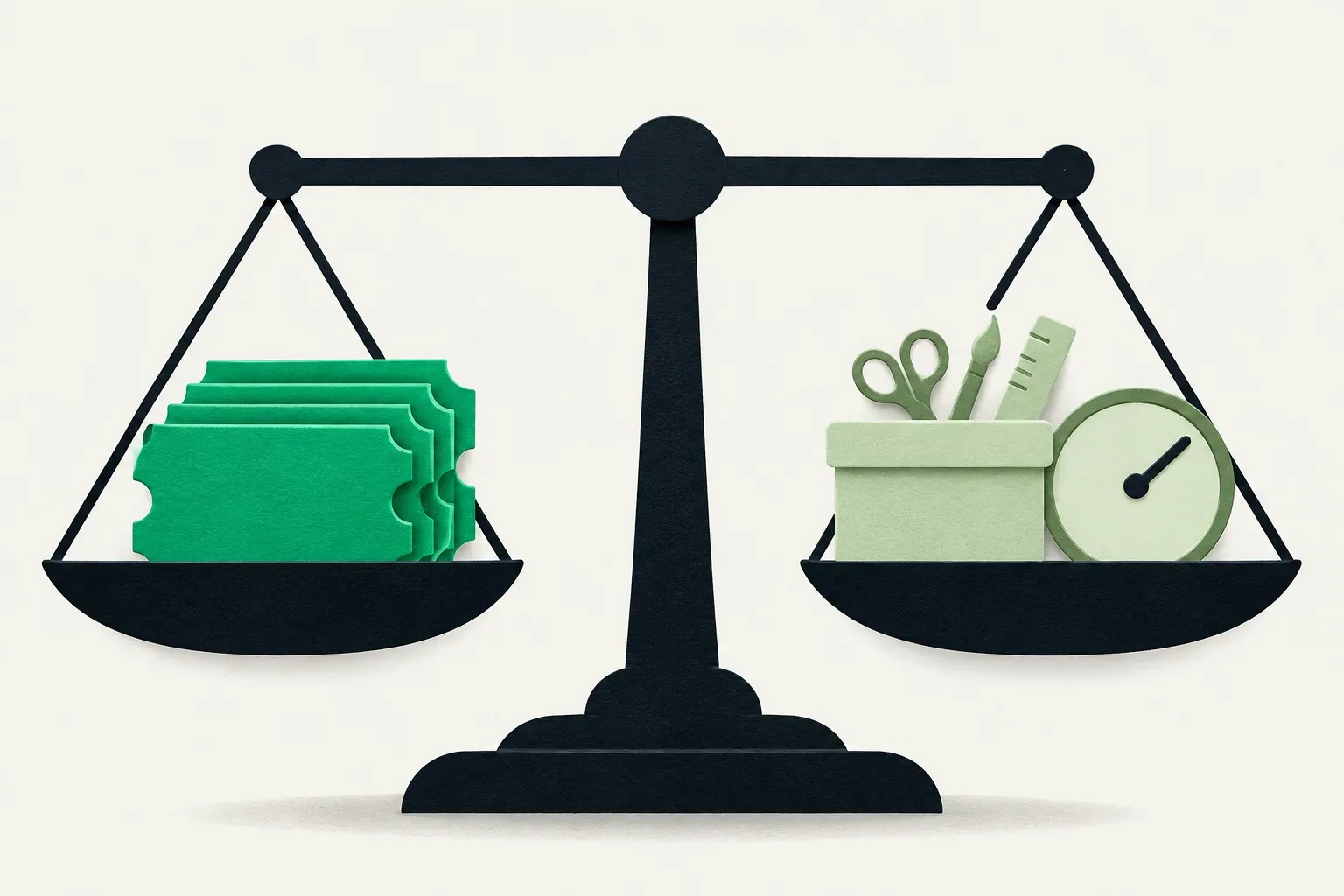
A workshop break-even calculation tells you how many paid places must cover the costs of one dated session. Count preparation and teaching time, the room, materials, payment costs and any complimentary guests before deciding whether the proposed ticket price can support the event.
Use the worksheet below for a single workshop or studio masterclass with one start and finish. The fictional example has 24 participant places, including two guests, and needs 17 paid places to cover its planned costs. Those numbers are an illustration, not a suggested price or attendance forecast.
Write down what you are costing
Give the sheet an event name, date, currency and revision date. Describe what one ticket includes, such as a two-hour session, materials and a finished item. A change from shared equipment to a take-home kit changes the costs even if the teaching lasts the same amount of time.
Record the participant limit separately. The room, equipment and teaching plan determine how many people you can host. A budget that needs more paid participants than the approved limit requires a different price or cost plan. Keep the event-page and purchase checks in the workshop ticket sales guide alongside the budget.
Choose one consistent accounting basis for the amounts with whoever keeps your accounts. Confirm tax treatment separately. The example uses currency units and leaves taxes out of the calculation; it does not specify what a real buyer should be charged.
Separate event costs from costs for each participant
Fixed event costs stay the same across the attendance range you are testing. A room hired for the session may cost the same with twelve or twenty participants. Your preparation, teaching and cleanup time also need an allowance, including when you deliver the workshop yourself.
Per-person costs increase as you add participants. List materials, refreshments and any item each person takes home. Eventbrite's ticket-pricing guide uses this fixed-versus-variable distinction when building an event budget. Check each supplier's actual terms before classifying a cost.
Some costs change in steps. You might need a second instructor above a certain group size, or have to buy supplies in packs. Record the threshold and the extra amount. A single per-person average can hide that jump.
The Hebrew Isracard guide to running workshops also identifies preparation, rent, equipment, materials and marketing as costs beyond the session itself. Work from your own quotes and time estimates rather than copying another organizer's ticket price.
Copy the 24-place cost worksheet
This fictional workshop has an approved participant limit of 24. Two places are complimentary, leaving at most 22 paid places. Every participant, including each guest, receives the same materials and refreshments.
| Cost item | Basis | Currency units |
|---|---|---|
| Room hire | Fixed for this event | 450 |
| Preparation, teaching and cleanup pay | Fixed for this event | 750 |
| Event promotion | Fixed budget | 180 |
| Planning reserve | Fixed allowance | 180 |
| Fixed event costs | Total of the four rows above | 1,560 |
| Materials | Per participant | 30 |
| Refreshments | Per participant | 10 |
| Participant costs | Per participant, including guests | 40 |
| Retained ticket and payment charges | Assumed per paid ticket for this example | 10 |
The planning reserve is an amount chosen for this example. Replace it with an allowance that reflects your event's uncertainties. Keep a note explaining what it covers so the same expense does not appear twice.
The paid ticket price is 150 currency units. The assumed charge of 10 is fictional, not a Skedful or payment-provider price. Replace it with the complete cost your chosen service retains under its current agreement.
If charges include both a percentage and a fixed amount per order, estimate them using the expected order sizes. One order containing three tickets may incur a different total charge from three separate orders. Keep the revenue calculation in tickets and the order-based charge calculation in orders.
Calculate what each paid place contributes
Start with the ticket price, subtract retained charges and subtract the costs caused by that paid participant. Here, 150 minus 10 minus 40 leaves 100 currency units per paid place to cover the event's fixed costs and the guests' supplies.
The U.S. Small Business Administration's break-even guide gives the basic calculation as fixed costs divided by the difference between unit price and variable unit cost. For this worksheet, add the complimentary participants' costs to the amount paid places must cover.
Two guests cost 2 × 40 = 80. The amount to cover is therefore 1,560 + 80 = 1,640. Divide 1,640 by the contribution of 100 and round up to a whole paid place: 17.
You can copy these three lines into a sheet:
- Contribution per paid place = ticket price minus retained charges minus per-person cost.
- Amount to cover = fixed event costs plus costs for complimentary participants.
- Required paid places = amount to cover divided by contribution per paid place, rounded up.
If contribution is zero or negative, additional sales at that price cannot cover the fixed costs under these assumptions. Review the offer, costs or price before opening sales. If the result exceeds the available paid places, revise the plan and calculate it again within the approved capacity.
Check several sales totals before committing
Run the same budget at different paid-ticket totals. Keep both guests in every row, and assume no further cost threshold applies within this example's 24-place limit.
| Paid places | Total participants with two guests | Ticket revenue | Planned result after all listed costs |
|---|---|---|---|
| 12 | 14 | 1,800 | -440 |
| 16 | 18 | 2,400 | -40 |
| 17 | 19 | 2,550 | 60 |
| 20 | 22 | 3,000 | 360 |
| 22 | 24 | 3,300 | 560 |
At 17 paid places, the calculation is 2,550 revenue minus 170 retained charges, 760 participant costs and 1,560 fixed costs, leaving 60. That result includes the planned pay and reserve already listed. It remains a planning result before costs or taxes omitted from the sheet.
A break-even threshold does not guarantee a worthwhile event. Set any additional earnings target explicitly and add it to the amount to cover before dividing. Check that the revised target still fits the number of paid places you can sell.
Recalculate when you add an early price
The contribution of an early ticket can differ from a standard ticket even when both include the same workshop. Use the ticket-type allocation worksheet to keep the quantities within capacity, then calculate the money from each type separately.
Suppose six paid places sell at 130 instead of 150, with the same assumed charges and participant costs. Each contributes 130 - 10 - 40 = 80, so the six contribute 480. They leave 1,640 - 480 = 1,160 to cover. At a standard contribution of 100, you need twelve standard paid places, rounded up from 11.6.
That plan needs eighteen paid places in total: six early and twelve standard. Add two guests and twenty people attend. Seventeen paid places would no longer cover the listed costs if six of them had the lower price. Recalculate before expanding a discounted allocation or offering additional complimentary places.
Set a decision date and keep unpaid holds separate
Record when you must confirm the room, place the materials order or commit to another non-recoverable expense. Choose an internal review date that leaves time for the actions available under your supplier agreements and published buyer terms. The worksheet does not establish a cancellation or refund policy.
At that review, compare confirmed paid sales with the required number. Keep unresolved payments in a separate column. Two active reservations may consume capacity without yet providing confirmed payment. Use the manual-payment reservation workflow for checking those orders and their deadlines.
Also list when payments become available to you and when suppliers must be paid. An event can cover its planned costs overall while still requiring money before ticket proceeds arrive. A refundable deposit is part of the payment schedule, not automatically an extra expense on top of the full room price. Show the full cost once and its payment dates separately.
Replace estimates after the workshop
Save actual paid quantities and prices, retained charges, total participants, supplies used and time spent. Compare each with the planned row. Record whether unused materials can be used at another event and how the cost was allocated, so the next worksheet starts from a documented figure.
Keep a revised quote or note beside any cost that changed. If a larger group needs extra instruction or equipment, include that cost before using the same price for another date. For an event you hope to manage with Skedful, contact the team with the date, country, participant limit and payment needs to confirm current ticketing availability and fit before committing to the sales setup.
About this article
Skedful is the publisher and corrections contact. Our editorial checklist covers product availability, source dates, worked examples and the limits of each claim.
About this articleWorked examples and sample calculations describe hypothetical scenarios. When an article cites research or customer results, follow the source for its context and limits.
Found an error? Send us the article link and the passage that needs a correction.
Report an error to SkedfulReminders come with every Skedful plan, on a schedule you set once. PricingSkedful vs Fresha vs Booksy